Kim Dent-Brown
What happens in a Tarot reading? Is the reader (if they are a good one) just an expert cold-reader and body language expert? Are they consulting the Akashic records? Are they channeling angels or spirits? Are they assembling meanings from the many books and websites they have consulted?
Different readers will have different explanations of what they are doing. Here is mine – it explains what I think is happening when I do a reading. No judgement is implied on what other people do or how they explain the activity.
I see the cards and the images on them as a projective tool, not very different from a Rorschach test. They have little or no inherent meaning until you, the querent, project one onto them. In a reading I never tell the querent what the cards mean at first, and the initial interpretation is always the querent’s and not mine.
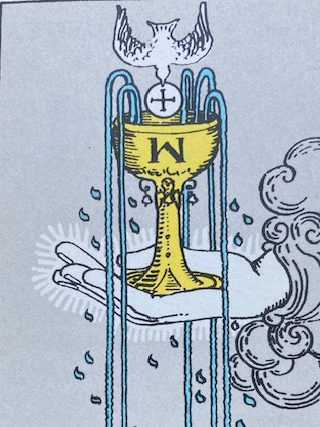
So I usually begin by just asking the querent to tell me what they see – as if they were describing the image to me over the phone and I had no knowledge of what they were looking at. Immediately, the words people use and the things they see will start to diverge. On looking at the Ace of Cups (above left) one person will see a Holy Grail, another a baptismal font, another a bird coming down to drink. These differences mean something and tell us something about the querent.
I then go on to as what impact the image has, what it reminds them of, what it means, how it connects with their question. Only when we have exhausted that conversation might I tell someone about the traditional meanings of the card. If they diverge or contradict what the querent has seen, I take their own meanings as primary.
And then we go on, to the next card in the reading and the next, and now we have a succession of images that may suggest a narrative or a story of some sort to the querent (not me…) and again we will elaborate that.
Why do I do readings this way? It is a method that has evolved over fifty years and only fairly recently did I discover that actually many other readers work in the same way. It is not ‘occult’ except in the sense that the word means ‘hidden’ and I do think the images can help people reveal things hidden in their subconscious.
Because of this method I prefer to use a deck that is rich in archetypal symbols such as the Smith-Waite deck. Often called the Rider-Waite in the past, many people are trying to add in the name of Pamela Colman Smith who actually designed the images on the cards. Prior to her work with Arthur Waite, Tarot decks had minor arcana (‘pip’ cards) that looked very plain, not unlike the suit cards in an ordinary deck of playing cards.
Waite designed the major arcana of his new deck carefully but seems to have given Smith a free hand in illustrating the minor arcana, resulting in one of the most influential suites of images in existence. Every card is open to a range of interpretations and has many possible elements to focus on. It is for this reason that I prefer the Smith-Waite deck to decks of ‘oracle cards’ which to me usually seem to have much fewer and less ambiguous potential meanings.
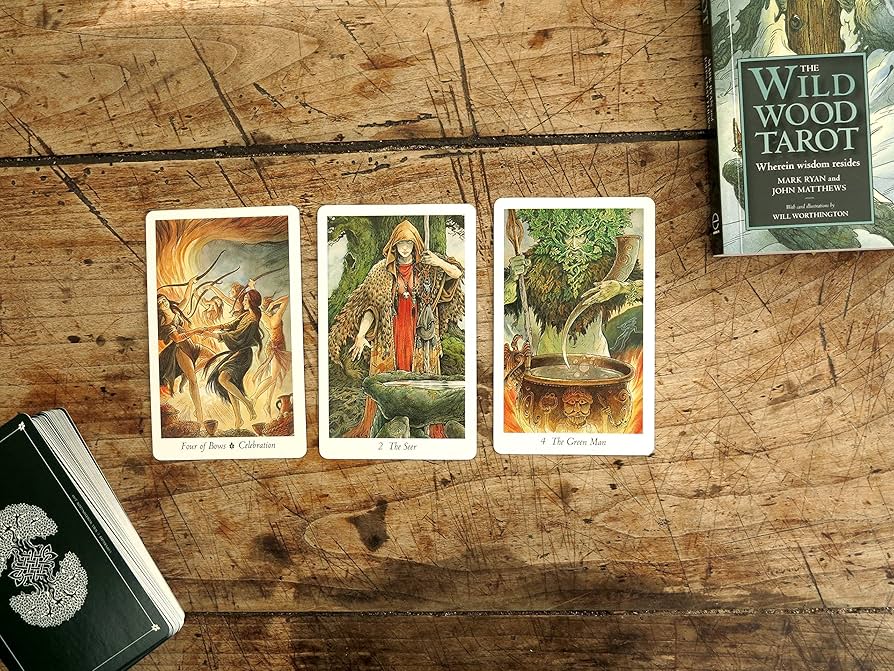
If I do a reading for you, I will likely use the Smith-Waite deck. I do also use the WildWood tarot which has a less challenging, more supportive feel if the querent needs something very positive out of the reading.
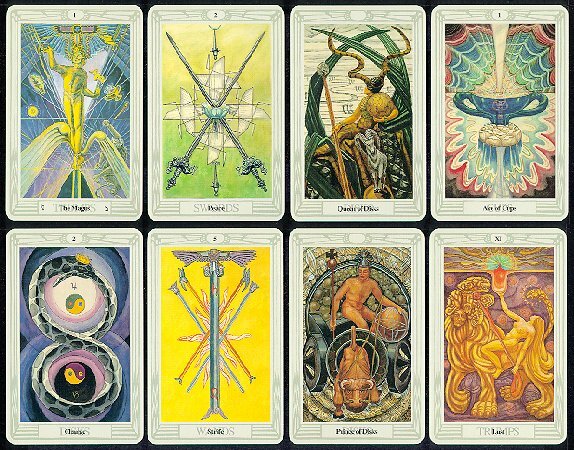
The other deck I sometimes use is the Thoth deck devised by Aleister Crowley and drawn by Frieda Harris. This is a very uncompromising deck which can feel uncomfortable to read and has as many negative cards as positive ones. I don’t recommend it as a first one to try but it has a level of honesty and directness that is very refreshing.
If you would like a personal reading I offer these at Brigid’s Well by personal request – please contact me via the Contact page. For a 90-minute Celtic Cross reading using one of these decks I charge £80. I am also doing a day of shorter readings at Silver Moon in Hornsea on 1st February 2025. For more details please see our Events page.
 Brigid's Well Home
Leave a comment